THE FLIPside of PUblishing: Finding Readers in an Age of Disinformation & Distraction
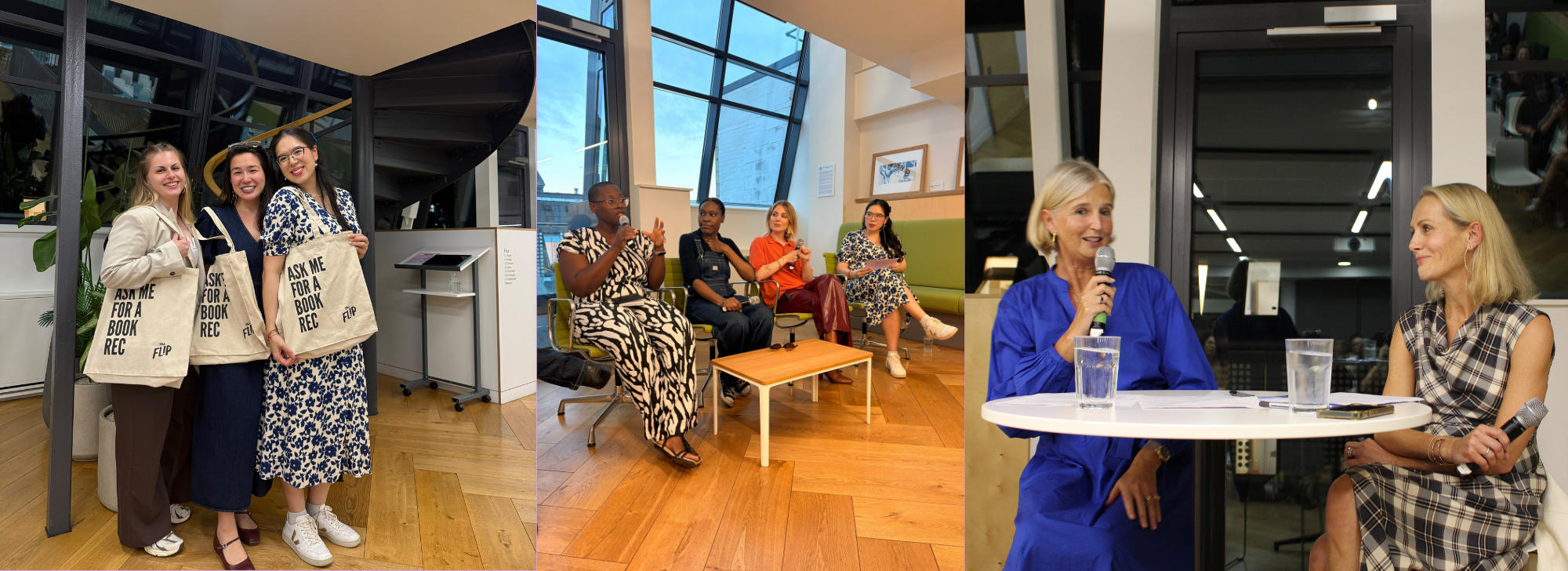
In September 2026, The FLIP hosted an in-person networking event to discuss finding readers in an age of disinformation and distraction. The evening featured a panel of experts comprising: Oenone Forbat, podcaster and author of Bad Influence; Cynthia Hamilton, Head of PR & Marketing at The History Press; Mercy Smartt, co-founder of the book-ends bookshop; and Sarah Wynn-Williams, author of Careless People. This was followed by an in-conversation discussion between publishing leaders Joanna Prior, CEO of Pan Macmillan, and Rebecca Sinclair, Chief Brand Officer at Penguin Random House. Below are some key takeaways from these discussions.
Panel: Do Books Still Matter? - What We Can Do To Ensure They Will
What one word would you use to describe books in our current landscape?
Cynthia Hamilton (CH): I’m going to go with friction-friendly because friction’s really important right now. I think people are actually seeking it; they want to add that back into their lives. Nothing does that better than a book because you actually have to spend time with it, don’t you?
In this new age of disbelief, in which it’s harder to find truth and authenticity, how can books and storytelling claim to be persistent and authentic in getting across a story from one individual to another?
Oenone Forbat (OF): I’m going to bastardize the James Baldwin quote I always think about which is ‘You think your pain is singular and that you’re the first person to experience this thing that’s happened to you and then you pick up a book and you read it and you go “Oh, every other person on earth in the history of humanity has gone through this lived experience.” and I think that’s a really crucial, important thing about books.
Is there a way that we can safely reach readers and build community and connection in the online space, without overwhelming them?
Sara Wynn-Williams (SWW): I think one important distinction in the online space is differentiating between spaces that are dictated by algorithms and non-algorithmic spaces. Because an algorithm kicks in and engagement metrics kick in and suddenly it seems like a few books are everywhere but obviously there’s a huge unspoken treasure trove. What I’m finding interesting is that more people are becoming attuned to the role algorithms play, and starting to ask really basic questions: “How do I find a place to find out about books that isn’t intermediated by an algorithm?” Another thing to differentiate online spaces, is also remembering the distinction between a recommendation you get online and a recommendation you get from someone in person and that there’s a mutuality [in the latter]. There’s a give and a take and a deepening of a relationship.
What can we do to raise more young people to be readers, especially those young people who don’t see reading as something for themselves or who don’t always find that reading comes naturally to them?
Mercy Smartt (MS): I think the more that we can support families, the more we can support parents and create a space where there is zero shame and zero guilt, because I’m always speaking to people who feel bad that they haven’t read a book because the book isn’t judging you. Sometimes books need to marinate for a while and when the time is right, you’ll pick it up and it’ll be the right time for that book. What’s been really good is being able to have real conversations, not just with parents but with the children themselves about what kind of things they like reading and it can be anything, it can be silly books, it can be books about farts!
I’m super passionate about creating a space that when any child comes into our shop, they feel welcome and we’re happy to see them there. Just the idea that they can have a good experience around books so that it doesn’t become something that is scary or shame-inducing, and particularly where you’ve got children who are legitimately struggling and it might not be that their parents know yet. In those moments when you’re trying to really reduce the amount of shame around reading, the permission to read however you want is paramount.
Does AI have a place at all in the world of books?
CH: You have to be a practitioner with it even if you don’t like it just because your job demands it. I would say for the History Press, and for a lot of publishers, not just us, we don’t want it anywhere near the creative elements of the process. In my department, the one role I will give it is to be in service to the people who do the job, so it gets the grunt work; AI in our company is like a really badly treated intern and that’s how it should be used. I think it could be incredibly useful but not on the creative front.
OF: I really think we should switch it off personally because it’s atrophying my brain. I think we’re all just going to end up being a lot more stupid for it and I think the antidote ironically is reading.
CH: I think what this whole conversation makes us really do is sit down and think about what human value is: how are we valuing being human; what is the difference between humanity and AI; what is the real threat that we think we’re seeing here; is there really a threat?
What one action would you like people to take into their day to day lives that reflect the values of the evening, or just further the conversations that we’ve been having today?
SWW: Someone recently explained to me that writers are pushers, that they like to either push other people to write books or to read books, and I decided I’m just going to take that as a compliment. That’s the value I’d like you to take away. This is obviously an audience that cares about books and are the torch bearers for books, so the more that you can be proactive and not leave it to the online space to just push books into people’s hands and then to also be conscious of the relationship that you’re building on top of it so that you are able to enrich your life as well as the lives of the people you push books onto.
MS: Two things: visibility, so by that I mean be seen reading more, almost as a revolutionary thing that you’re doing. The vision of people not just being phone in hand all the time - that is an encouraging thing and sometimes seeing someone else with a book can be a powerful reminder. The other part of that is greater self-acceptance, especially around what we enjoy when it comes to reading.
OF: Don’t read Goodreads until after you’ve read the books. You don’t need to know what everyone thinks; if you like something, just like it.
CH: No guilty pleasure, just pleasure.
How do we balance free speech with reader safety?
OF: We should all be encouraging free speech for the very reasons I said before; that if you take it away from one group you also take it away from yourself.
CH: It’s pretty important to be able to engage with ideas that aren’t your own and there was a lot more of that before we had the internet and social media. It keeps your mind sharp, because your mind is like a pencil and it should be sharp at all times, shouldn’t it? It does really help to introduce enough friction to have those sorts of conversations.
How do you feel about the rise in performative reading, especially on social media?
SWW: People are getting so smart! They can tell the difference between someone who’s toting a book around and someone who’s actually read a book. Both serve different functions and I don’t know that all the celebrities who have celebrity book clubs actually read those books or whatever, but the fact that they’re signalling that they think reading is important, or performing reading is important - it’s better than the alternative!
In Conversation with Joanna Prior (OBE) and Rebecca Sinclair
What was different about the industry when they started out?
Rebecca Sinclair (RS): It was different in that we were dealing with crises and issues but it was slower paced, there was no social media, there were boundaries in that stories could be contained to a market. Of course, all of that is gone now; all that friction is gone but some things stay the same, I think, in terms of comms: The value of a well-crafted message, really thinking about your audience, the power of community and connection, the personal touch.
On Marjorie Scardino’s leadership and values
Joanna Prior (JP): She said: “Will it make us proud, will it make us rich, will it make us happy? You don’t need to do all three but you need more than one”. I’ve never forgotten that. I do think about that when we’re making all sorts of decisions actually.
RS: She also used to say “always err on the side of generosity” which has really stuck with me.
What advice would you have given your younger self? What things would you have told them not to worry about?
RS: I would have told myself to not put so much pressure on myself as a working mum. Children are pretty resilient; they’re going to turn out okay so less guilt around that but also, as a working mum, I am so pleased that I work in an industry that I believe in and that connects with my passion and purpose because that made not being at home with my girls worthwhile. I would have said to myself something about timing; I think so much of life is about timing: sometimes decisions aren’t right at particular moments in time, so have patience. Take opportunities, have adventures, put yourself out of your comfort zone.
How, as an industry, can we ensure that publishing provides a genuinely radical welcome to a wider range of perspectives?
JP: I think part of it is a lack of judgement. We really just want people to read books. We really believe in the transformational power of books and reading and therefore part of a radical welcome is completely lowering the barriers. This obviously means access, but also means the ways in which we talk about it. As somebody who has worked on literacy campaigns and reading campaigns for a really long time, I feel that finally we’re cracking something by talking about books as being fun and for us to take our campaign to people where they are rather than expecting them always to come to us.
It’s also about inclusivity in publishing and making sure that we have got the books for everyone. We both work for big companies with large children’s departments, but it’s not just a children’s issue; we want the books for all audiences and that’s about all kinds of inclusive publishing. It’s a commitment to publishing for everyone, and it’s a commitment to saying all are welcome at any time, and in any form.
When should we collaborate instead of compete?
JP: Market share really matters so the competition for the success of our authors and our books is unbelievably healthy because that’s the commitment that we’re making to our authors and everything we are doing by the way is in service of them. We have to drive as hard as we can to get to the top for them and for them to get to the top but what we’re not competing for, ultimately, is a readership and a pipeline of readers for the future. What we are all trying to do, I hope, is to grow that pool and to grow the number of people who want to read. The places where we should collaborate are in those areas where we’re trying to improve the conditions to make that happen. Whether that is protecting our intellectual property and advocating for that, whether it is around diversity and inclusion initiatives that will really help expand the pool for us all, whether it is literacy drives and so on – these are the areas, I think, where collaboration is going to be just way more fruitful. These problems are too big for any one company. They need the whole industry.
On AI
RS: Because of the complexity of the world, it is possible for two things to be true at the same time. We can all have our own personal fears and anxieties about AI but, on the other hand, we do have to engage with it: it is reality, it’s here. On the other hand, this world of abundant content, algorithms, noise, signals – we need to engage with that too, and there are some good things about it like TikTok, for example, has really driven a real renaissance in reading. At the same time, there’s a really interesting space emerging that we can move into which is a desire for more human storytelling, more authenticity, people wanting trust, people wanting to unplug, people wanting to focus on their mental wellness. All of those things combined means there is this amazing space that we can move into but that doesn’t make it not frightening.
Will AI take away entry level jobs and career pathways in the creative industries?
JP: There are still entry level jobs, but I do think the expectation for those jobs has probably got higher and the skills that employers look for are going to be different and are changing. I do think – certainly speaking for Pan Macmillan – we’re certainly not looking in terms of fully formed people ready to go, but what we want is people who are curious and experimenting, probably with the new technology, in almost any role that they’re coming into.